
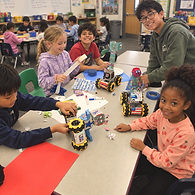
"Happy kids, happy families,
happy teachers!"
Greg Miller
Summer Robotics Camp Principal
Orange USD
Expanded Learning with Robotics (TK-12)
A Standards-Aligned Learning Solution
Expanded Learning with Robotics extends learning beyond the regular classroom through engaging, standards-aligned mathematics, STEAM, computer science, engineering design, and robotics learning experiences. It serves as both an engaging entry point into the RoboBlocky Curriculum for new students and a natural extension of classroom learning for students already using RoboBlocky.
Expanded Learning with Robotics provides schools and districts with a flexible, standards-aligned learning solution for Expanded Learning Opportunities Programs (ELO-P), afterschool, summer, intersession, mathematics intervention and enrichment, MTSS and credit recovery, academic acceleration, makerspaces, and community learning programs.
Using the same robot and platform from TK through Grade 12, students develop mathematics, STEAM, computer science, engineering design, creativity, collaboration, communication, and real-world problem-solving skills through engaging hands-on robotics experiences.
Schools and districts may begin with a single grade level, school site, summer program, or afterschool program and expand over time as participation and instructional goals grow.
Curriculum Options
Expanded Learning with Robotics includes:
-
Robotics Curriculum for Expanded Learning
-
Robotics-Math Curriculum for Expanded Learning
-
Selected RoboBlocky Math™ Intervention and Enrichment courses
-
RoboBlocky Math™
Why Schools and Districts Choose
Expanded Learning with Robotics

Expanded Learning with Robotics helps schools and districts:
-
Provide engaging, standards-aligned expanded learning experiences.
-
Support mathematics, STEAM, computer science, engineering design, and robotics through one coherent TK–12 learning ecosystem.
-
Support mathematics learning through grade-level instruction, acceleration, intervention, enrichment, MTSS, and credit recovery.
-
Develop computational thinking, engineering design, creativity, collaboration, communication, and real-world problem-solving skills.
-
Provide meaningful culminating learning experiences through schoolwide and districtwide RoboParade™, RoboEngineering Expo™, and RoboPlay™ Competitions during the academic year, and through mini RoboParade™, RoboEngineering Expo™, and RoboPlay™ showcase events in summer and other short-term programs.
-
Develop student leadership through peer mentoring and service learning.
-
Support sustainable implementation by using the same robot, platform, curriculum resources, and professional development across multiple programs and grade levels.
Structured Expanded Learning
Curriculum Resources

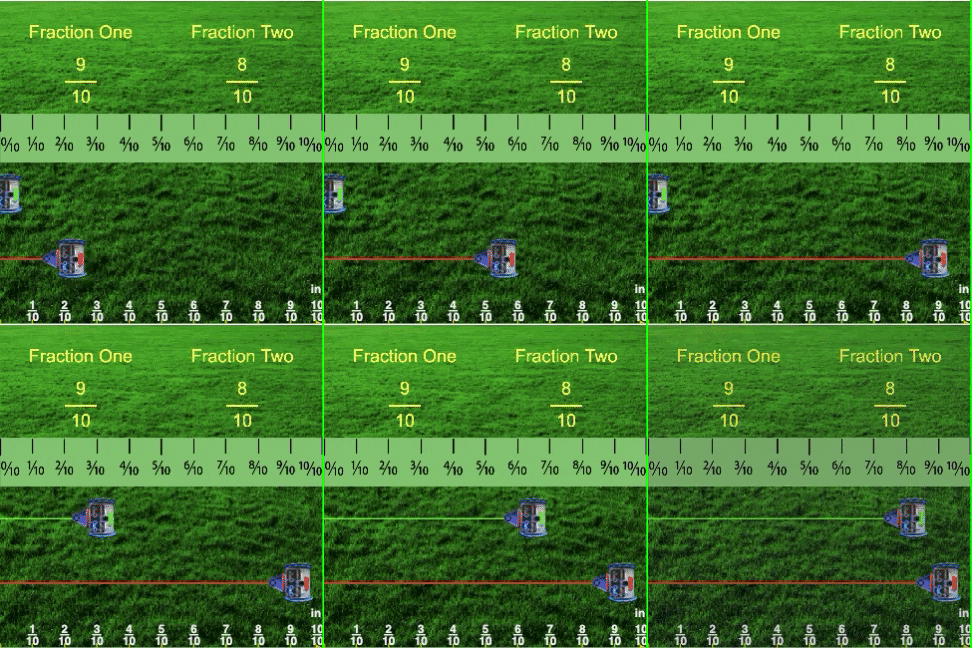

Expanded Learning with Robotics combines structured curriculum with flexible, student-centered exploration and creativity.
To help schools and districts get started, the following curriculum resources provide structured learning experiences and implementation guidance:
-
Robotics Curriculum for Expanded Learning
-
Robotics-Math Curriculum for Expanded Learning
-
Selected RoboBlocky Math™ Intervention and Enrichment courses
-
RoboBlocky Math™
These curriculum options enable schools and districts to select the level of mathematics, robotics, STEAM, computer science, and engineering design that best meets the needs of their students and expanded learning programs.
Building upon these structured curriculum experiences, students have opportunities to engage in the broader RoboBlocky Curriculum, including Engineering Design with Robotics, Computational Storytelling, physical computing with Arduino and sensor-based robotics, RoboParade™, RoboEngineering Expo™, RoboPlay™ Competitions, and many other engaging robotics learning experiences.
Robotics Curriculum for Expanded Learning
The Robotics Curriculum emphasizes:
-
STEAM
-
Computer Science
-
Engineering Design
-
Robotics
-
Computational Storytelling
-
Creativity
-
Project-Based Learning
Available in five grade bands:
-
Robotics: Grades TK–K
-
Robotics: Grades 1–2
-
Robotics: Grades 3–5
-
Robotics: Grades 6–8
-
Robotics: Grades 9–12
Robotics-Math Curriculum for Expanded Learning
The Robotics-Math Curriculum strengthens grade-level mathematics through coding, robotics, engineering design, and authentic real-world problem solving while supporting both accelerated learning and intervention.
Available in five grade bands:
-
Robotics-Math: Grades TK–K
-
Robotics-Math: Grades 1–2
-
Robotics-Math: Grades 3–5
-
Robotics-Math: Grades 6–8
-
Robotics-Math: Grades 9–12
RoboBlocky Math™ for Expanded Learning
Schools and districts not currently using RoboBlocky Math™ as their core mathematics curriculum may implement the full grade-level RoboBlocky Math™ curriculum during afterschool, summer, intersession, and other expanded learning programs to provide additional standards-aligned mathematics instruction.
Using RoboBlocky Math™ with student licenses and workbooks provides a structured approach to strengthening conceptual understanding, mathematical reasoning, and problem solving through coding, manipulatives, and robotics.
Expanded learning implementation can also provide schools and districts with experience using RoboBlocky Math™ before considering broader classroom implementation.
Intervention and Enrichment Courses
Schools may also implement selected RoboBlocky Math™ Intervention and Enrichment courses during Expanded Learning, summer, afterschool, MTSS, intervention, enrichment, or credit-recovery programs.
Available courses include:
-
Robotics Fractions (Grades 5-6)
-
Robotics Pre-Algebra (Grades 6-8)
-
Robotics Algebra (Grades 9-12)
-
Sensor-Based Robotics Geometry (Grades 10-12)
-
Math Exploration with Coding and Robotics (Grades 6-8)
-
Math Lab with Coding and Robotics (Grades 9-12)
Student Learning Beyond the Classroom
Building upon the structured curriculum experiences provided through Expanded Learning with Robotics, students have additional time and flexibility to explore personal interests, pursue creative projects, strengthen foundational skills, accelerate learning, collaborate with peers, and apply their learning through authentic, hands-on experiences that strengthen mathematics, STEAM, computer science, engineering design, creativity, communication, and real-world problem-solving skills.

Explore, Create, and Innovate
Expanded Learning with Robotics provides opportunities that are often difficult to provide during the regular school day. Building upon structured curriculum experiences, students have additional time and flexibility to explore personal interests, pursue creative projects, strengthen foundational skills, accelerate learning, collaborate with peers, and apply their learning through authentic hands-on experiences.
Students have opportunities to engage in:
-
Computational Storytelling
-
Engineering Design with Robotics
-
Design, Build, and Program Their Own Robot Machines
-
Physical Computing with Arduino and Sensor-Based Robotics
-
RoboParade™
-
RoboEngineering Expo™
-
RoboPlay™ Competitions
These authentic learning experiences help students:
-
Strengthen foundational mathematics skills
-
Explore more advanced mathematics, computer science, and engineering concepts
-
Develop computational thinking and engineering design skills
-
Apply mathematics, coding, robotics, and computer science to authentic real-world problems
-
Collaborate with peers on open-ended engineering and robotics projects
-
Develop creativity, communication, confidence, leadership, student agency, and real-world problem-solving skills
Peer Mentoring and Service Learning
Expanded Learning naturally creates opportunities for peer mentoring and service learning.
Experienced middle school, high school, and college students as well as high school and college interns may serve as:
-
Assistant coaches
-
Peer mentors
-
Robotics facilitators
-
Student leaders
-
Team leaders
-
Event volunteers
These authentic leadership experiences strengthen communication, collaboration, leadership, presentation, organization, and teaching skills while providing meaningful service to younger students.
Students may also mentor younger participants and help organize RoboParade™, RoboEngineering Expo™, and RoboPlay™ Competitions, creating cross-grade learning communities that benefit both mentors and younger learners.
Sustainable District Implementation
Expanded Learning with Robotics is designed to support sustainable implementation across schools, grade levels, and programs.
Schools and districts may:
-
Share robotics equipment between classroom instruction and expanded learning programs.
-
Rotate robotics kits among grade levels, schools, and program sites.
-
Use the same robot and platform across mathematics, STEAM, computer science, engineering design, intervention, enrichment, afterschool, and summer programs.
-
Continue using robotics equipment purchased for classroom instruction during afterschool, summer, and expanded learning programs.
-
Provide professional development for teachers, expanded learning staff, paraeducators, and college instructors using the same instructional resources.
A relatively small inventory of robotics equipment can therefore support large numbers of students throughout the school year while providing a coherent TK–12 robotics learning ecosystem.
Programs may begin with a small number of robotics kits and expand over time as participation grows.
Professional Learning
Expanded Learning with Robotics is designed for easy implementation.
Programs may be led by:
-
Teachers
-
Expanded Learning staff
-
Paraeducators
-
College students
Professional Learning is available for both new and experienced instructors. Professional Learning may be delivered through a full-day workshop or a series of shorter workshops to accommodate district scheduling needs.
No previous coding or robotics experience is required for instructors or students.
Supporting High-Quality Expanded Learning
Expanded Learning with Robotics supports the goals of high-quality expanded learning by providing engaging, student-centered learning experiences that complement the regular school day while developing academic, technical, communication, collaboration, creativity, leadership, and real-world problem-solving skillss.
Its flexible implementation model aligns well with Expanded Learning Opportunities Programs (ELO-P), ASES, 21st Century Community Learning Centers, summer learning, intervention, enrichment, and other expanded learning initiatives throughout California and across the United States.
One Robot. One Platform.
Unlimited TK-12 Learning Opportunities.

Using the same robot, platform, curriculum, and professional learning across classroom instruction and expanded learning enables schools and districts to support sustainable implementation while enabling programs to grow with students and extend mathematics, STEAM, computer science, and engineering design learning through robotics from TK through Grade 12.
District Success Stories


School districts throughout California are successfully implementing Expanded Learning with Robotics.
Featured implementations include:
-
Hacienda La Puente USD — Nearly 800 students participate annually in one of the California's largetst district-wide summer robotics program.
-
Orange USD — Successful summer robotics pilot serving approximately 100 TK-8 students.
-
Fresno USD — Mathematics intervention and academic acceleration through the Advancing Academic Acceleration & Achievement (A4) Program.
-
Alvord USD — Afterschool robotics programs culminating in districtwide RoboPlay™ Competitions.
