RoboBlocky Platform

One Platform. Unlimited TK-12 Learning Opportunities.
The RoboBlocky Platform is a comprehensive Integrated Teaching and Learning Environment for TK–12 mathematics, STEAM, computer science, engineering design through robotics in both classroom instruction and expanded learning.
RoboBlocky integrates curriculum, instruction, assessment, classroom management, robotics programming, physical computing, and teacher innovation into one coherent learning environment.
Students learn using the same platform from elementary school through high school while progressing naturally from visual programming to authentic C/C++ programming. Teachers use the same environment to manage classrooms, deliver curriculum, assign lessons, monitor progress, create instructional resources, and support personalized learning.
The result is a unified educational ecosystem that supports students, teachers, schools, and districts throughout their entire instructional journey.
Schools can begin implementation at any grade level and expand over time while continuing to use the same platform, curriculum, robotics hardware, instructional model, and professional learning resources.
An Integrated Teaching and Learning Environment
RoboBlocky Platform combines the essential components of modern STEM education into one integrated platform.
Students can:
-
Learn mathematics through programming
-
Program virtual and physical robots
-
Explore engineering design
-
Develop computational thinking
-
Create interactive projects
-
Build physical computing applications
-
Complete assignments and assessments
-
Participate in project-based learning
Teachers can:
-
Deliver curriculum
-
Create and manage classes
-
Monitor student progress
-
Assess student learning
-
Differentiate instruction
-
Provide timely feedback
-
Create lessons, projects, and assessments
-
Develop district-specific instructional resources
Rather than requiring multiple disconnected software systems, RoboBlocky provides one consistent environment that supports teaching and learning from beginning exploration through authentic programming and engineering design.
Low Floor. High Ceiling.


The RoboBlocky Platform is designed around the educational principle of Low Floor. High Ceiling. Students can begin learning as early as TK with intuitive, engaging activities and continue growing through Grade 12 using the same platform.
As their knowledge and confidence grow, students naturally develop mathematical literacy, computational thinking, and programming skills, progressing from block-based coding to standard C/C++ programming, robotics, engineering design, and physical computing. Teachers likewise begin with ready-to-use curriculum resources and progressively create their own lessons, activities, projects, assessments, and RoboPlay™ Adventures and RoboPlay™ Challenges as their expertise grows.
This design supports every learner, every teacher, and sustainable district implementation.
Curriculum Delivery and Learning Resources
The RoboBlocky Platform provides a comprehensive environment for delivering curriculum and instructional resources throughout the school year.
The RoboBlocky Curriculum includes more than 17,000 lessons and activities, Big Idea Tasks, Big Idea Projects, Engineering Design with Robotics resources, Computational Storytelling projects, Holiday Activities, RoboPlay™ Adventures, RoboPlay™ Challenges, research-informed instructional frameworks, and a comprehensive collection of teacher and student instructional resources, including implementation guides, downloadable teaching materials, graphic organizers, project templates, assessment resources, printable classroom materials, and reference guides.
Teachers can deliver complete instructional units, assign individual lessons, organize project-based learning experiences, and supplement existing mathematics and computer science curricula. Curriculum resources support both comprehensive implementations and flexible integration into existing classroom instruction.
Integrated Learning Management System

The RoboBlocky Platform includes an Integrated Learning Management System (LMS) that supports classroom instruction, assessment, and curriculum implementation.
Classroom and Student Management
Teachers can efficiently organize and manage instruction by:
-
Creating and managing classes, class periods, and student groups
-
Adding co-instructors and sharing classes
-
Archiving and reusing classes
-
Monitoring student engagement and participation
-
Supporting secure authentication through Google, Microsoft, and Clever Single Sign-On (SSO)
Assignment and Project Management
Teachers can assign and manage:
-
Lessons and activities
-
Homework and classwork
-
Engineering design projects
-
Coding assignments
-
Student file submissions
-
Tests and assessments
Assignments can be shared, copied, organized, and reused across classes and school years, simplifying curriculum implementation while supporting differentiated instruction.
Assessment and Progress Monitoring
The platform enables teachers to:
-
Monitor student progress and learning outcomes
-
Track student engagement
-
Provide timely feedback and grades
-
Support auto-graded learning activities
-
Review student coding projects and submissions
Real-Time Classroom Interaction
Built-in instructional tools allow teachers to:
-
Launch assignments instantly
-
Monitor student progress during instruction
-
Conduct formative assessment using the integrated Classroom Response System
-
Send prompts and questions directly to students
-
Guide classroom learning in real time
By integrating classroom management, curriculum delivery, assignments, assessment, and real-time classroom interaction into one platform, the RoboBlocky LMS allows teachers to spend less time managing technology and more time supporting student learning.
Personalized and Differentiated Learning
The RoboBlocky Platform enables teachers to efficiently implement personalized and differentiated instruction while maintaining high academic expectations for every learner.
Teachers can:
-
Differentiate assignments for individual students and student groups
-
Monitor student progress and adjust instruction as learning needs evolve
-
Support intervention, on-level instruction, enrichment, and acceleration
-
Support English learners, advanced learners, at-promise learners, and students receiving specialized learning support
-
Personalize instruction through multilingual support, accessibility features, and flexible learning pathways
Working together with the RoboBlocky Curriculum, the platform helps teachers personalize instruction while maintaining consistent classroom management, meaningful progress monitoring, and high expectations for every student.
From Block-Based Coding to Text-Based Programming
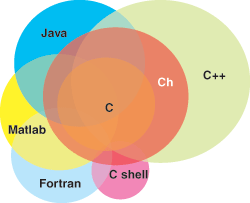

One of the RoboBlocky Platform's most distinctive capabilities is its seamless progression from block-based coding to standard text-based programming using the C/C++ Interpreter Ch.
Students begin by creating programs with intuitive RoboBlocky blocks while developing computational thinking and problem-solving skills. As they become more experienced, RoboBlocky automatically generates standard C/C++ code from their block-based programs, helping students understand the programming concepts behind the blocks while strengthening their understanding of computer science.
RoboBlocky Platform enables students to move naturally between the two using the same programming concepts, robots, platform, and instructional environment. Students can view, edit, execute, and experiment with the generated C/C++ code, discovering how block-based programming translates into authentic text-based programs.
The C/C++ Interpreter Ch removes unnecessary technical barriers by allowing students to write and execute standard C/C++ programs without first learning #include directives, the main() function, project configuration, or repetitive compile-link-run cycles. Students can focus on learning programming concepts rather than software development tools.
For example, students can simply write:
printf("Hello, World!");
This single C statement can be executed immediately as a complete C program. As students gain experience, they naturally progress to writing complete C/C++ programs while continuing to use the same interactive programming environment.
By learning standard C/C++, students gain experience with one of the world's most widely used programming languages while developing knowledge and skills that are directly transferable beyond the RoboBlocky Platform. Standard C/C++ provides access to an extensive ecosystem of textbooks, tutorials, online courses, libraries, open-source projects, programming communities, online reference materials, and AI assistants. Students can read existing C/C++ code, learn from published examples, explore online resources, and use AI assistants to better understand programming concepts, explain code, debug programs, and extend their learning. Likewise, teachers can leverage this wealth of instructional resources to enrich classroom learning, incorporate authentic examples, and connect students with the broader computing community.
Teachers consistently report that introducing text-based programming helps students better understand the programming concepts behind RoboBlocky blocks. Rather than viewing block-based and text-based programming as separate experiences, students discover that they represent the same computational ideas expressed in different forms, strengthening their understanding of algorithms, variables, functions, program structure, abstraction, and computational thinking.
Learning Mathematics Through Programming

The C/C++ Interpreter Ch was designed not only for programming, but also for Learning Mathematics Through Programming. RoboBlocky transforms programming into a powerful environment for exploring mathematics, computational thinking, robotics, engineering design, and authentic real-world problem solving.
Programming becomes more than a way to control robots. It becomes a mathematical tool for investigating ideas, modeling real-world situations, analyzing data, and solving meaningful problems. Rather than solving isolated exercises, students learn to recognize patterns, generalize solutions, and develop reusable computational models that solve entire classes of related problems. This process strengthens mathematical reasoning while developing computational thinking.
Beyond programming, the C/C++ Interpreter Ch provides a rich educational computing environment that includes Computational Arrays and built-in mathematical visualization tools, including:
-
Function plotting
-
Bar graphs
-
Histograms
-
Box-and-whisker plots
-
Statistical visualization
-
Graphical data exploration
Together with integrated graphics, robotics, and physical computing libraries, the RoboBlocky Platform provides a comprehensive environment for mathematical exploration, computational thinking, engineering design, robotics, data analysis, and authentic real-world problem solving.
By removing unnecessary technical barriers while preserving the richness and expressive power of standard C/C++, RoboBlocky enables students to experience success with authentic programming. Students develop confidence through genuine accomplishment while learning not only how to program, but also how to think computationally, explore mathematics through programming, and solve meaningful problems through robotics and engineering design.
Interactive Exploration with the C Prompt
One of the RoboBlocky Platform's most distinctive educational features is the C Prompt, an interactive environment that allows students to execute individual C/C++ expressions and statements immediately. Instead of waiting until an entire program is written, students receive immediate feedback as they explore ideas, investigate mathematical concepts, and develop authentic programming skills.
Programming
Students can interactively execute standard C/C++ expressions and statements individually.

Students can experiment with variables, expressions, functions, formatted output, and programming concepts before writing complete programs. As they gain confidence, they naturally apply these same statements when developing larger C/C++ programs for mathematics, robotics, engineering, and physical computing.
Mathematics
Students can also investigate mathematical concepts interactively by evaluating expressions and immediately observing the results.

These simple explorations naturally lead to discussions about:
-
Order of operations
-
Integer and floating-point arithmetic
-
Variables and data types
-
Numerical precision and rounding
-
Formatted output
-
Computational thinking
-
How computers represent and process numbers
Unexpected results often spark curiosity. Students naturally ask "Why?", creating meaningful opportunities to explore both mathematics and computer science while strengthening conceptual understanding.
The C Prompt and writing complete C/C++ programs continually reinforce one another. Students use the C Prompt to explore ideas, test programming statements, investigate mathematical concepts, and debug code before incorporating those same ideas into larger programs. As they gain experience, they transition naturally from interactive exploration to developing complete applications.
From Exploration to Real-World Problem Solving


The RoboBlocky Platform enables students to learn through exploration, experimentation, programming, and problem solving. Rather than starting from a blank screen, students are supported with carefully designed sample programs that provide appropriate scaffolding throughout the curriculum. Whether using RoboBlocky block-based coding or standard text-based programming, students learn to read, understand, modify, extend, and create programs while developing mathematical literacy, computational thinking, and problem-solving skills.
As students adapt existing programs to solve new problems, they recognize patterns, generalize solutions, and develop reusable computational models while gaining confidence in programming. This process helps students understand that programming is not simply writing code—it is a powerful tool for solving classes of related mathematical and real-world problems.
Authentic applications make programming concepts meaningful. Students might develop a program that calculates the cost of purchasing yogurt by applying discounts and sales tax, then prints a professional receipt with monetary values displayed to exactly two decimal places. Through applications like this, students naturally learn variables, arithmetic expressions, percentages, numerical precision, formatted output, and program organization because the real-world problem requires them, not because they are isolated programming exercises.
Programming becomes more than writing code—it becomes a process of exploration, mathematical reasoning, computational thinking, and solving authentic real-world problems.
Virtual and Physical Robots
The RoboBlocky Platform seamlessly integrates virtual and physical robotics, enabling students to learn programming, mathematics, engineering, and computational thinking through authentic hands-on learning experiences.
A single RoboBlocky program can control virtual robots, physical robots, or both simultaneously. Students can develop, execute, test, and debug programs while observing the corresponding behavior of virtual and physical robots. There is no need to rewrite or adapt programs when transitioning from simulation to real robots.
The RoboBlocky Platform extends this seamless experience through virtual activity mats that correspond directly to the physical activity mats used in classrooms. Students can develop, run, and test programs using virtual robots on virtual activity mats before seamlessly transitioning to physical robots on the corresponding activity mats. This unique capability integrates virtual and physical robotics into one seamless learning experience.
Using the same programming environment, students can:
-
Program virtual and physical robots with the same code
-
Develop, run, test, and debug programs interactively
-
Transition seamlessly between virtual and physical activity mats
-
Explore mathematical concepts through robotics
-
Design, build, and evaluate engineering solutions
-
Participate in RoboPlay™ Adventures and RoboPlay™ Challenges
Virtual and physical robots complement one another throughout the learning process. Virtual robots provide immediate access for exploration, experimentation, and debugging, while physical robots bring programs to life through authentic hands-on experiences. Together, they help students build confidence while strengthening programming skills, mathematical reasoning, computational thinking, and engineering design.
This integrated approach enables schools and districts to:
-
Expand access to robotics education
-
Maximize investments in robotics hardware
-
Increase student access to hands-on robotics experiences
-
Support flexible implementation across classrooms, computer labs, makerspaces, after-school programs, and home learning
-
Provide one seamless learning experience across virtual and physical robotics
Physical Computing


The RoboBlocky Platform supports Physical Computing with Arduino and Sensor-Based Robotics, enabling students to design, build, and program interactive electronic systems.
Students explore:
-
Arduino programming
-
Sensors and actuators
-
Embedded systems
-
Electronics
-
Engineering design
-
Real-world problem solving
The RoboBlocky Platform enables students to design interactive systems that combine software with sensors, motors, LEDs, buttons, actuators, and other electronic devices. Students learn how software interacts with hardware to collect data, respond to changing conditions, and control physical systems.
Physical computing projects encourage students to apply programming, mathematics, engineering, and design thinking while developing solutions to authentic problems. These experiences help students understand how modern intelligent systems—including robotics, embedded systems, smart devices, and Internet of Things (IoT) technologies—integrate software with physical hardware.
Accessibility and Multilingual Learning


The RoboBlocky Platform includes accessibility and multilingual learning features that help teachers create inclusive learning environments where every student can participate successfully.
Built-in features include:
-
Audio support that reads instructional text aloud
-
Online translation of lesson and activity text and audio into 18 languages
-
Multilingual programming experiences using robot speech and display functions
-
English and Spanish printed mathematics student workbooks, with online translation extending instructional support to many additional languages
-
Flexible instructional tools that support diverse learning needs
-
Integrated accessibility features that support English learners and students receiving specialized learning support
These capabilities help teachers make mathematics, programming, robotics, and engineering more accessible while supporting personalized instruction and maintaining high expectations for every learner. By combining multilingual online lessons and activities, audio support, and printed student workbooks, the RoboBlocky Platform helps schools better serve multilingual classrooms while providing a consistent learning experience for all students.
Empowering Teacher Innovation and
Curriculum Development
Teachers are not limited to using existing instructional materials. The RoboBlocky Platform empowers educators to become instructional innovators and curriculum developers.
Teachers can:
-
Copy and adapt RoboBlocky Lessons and Activities.
-
Create original lessons, activities, projects, and assessments.
-
Develop RoboPlay™ Adventures and RoboPlay™ Challenges.
-
Organize and share instructional resources.
-
Improve instruction while maintaining curriculum coherence.
-
Develop district-specific instructional materials
These resources can be customized to align with district priorities, state standards, local curricula, and individual classroom needs.
Just as computer science empowers students to become creators rather than consumers of technology, the RoboBlocky Platform empowers teachers to become instructional innovators and curriculum developers rather than consumers of instructional materials.
Project-Based Learning
The RoboBlocky Platform supports authentic project-based learning across mathematics, STEAM, computer science, and engineering design through robotics. Students apply mathematics, programming, robotics, engineering design, creativity, collaboration, and communication while developing authentic solutions to meaningful challenges.
Students can develop, revise, submit, and showcase:
-
Engineering Design with Robotics projects
-
Computational Storytelling projects
-
Mathematics investigations
-
Robotics design challenges
-
Physical computing projects with Arduino and sensor-based robotics
-
Student innovation projects
Proven Success in Classrooms.
Sustained at District Scale.
The RoboBlocky Platform is designed not only to provide students with access to mathematics, STEAM, computer science, engineering design through robotics, but also to help them experience success. By removing unnecessary technical barriers while maintaining high expectations, RoboBlocky enables students to build confidence, strengthen mathematical reasoning and computational thinking, and develop authentic programming skills through engaging, hands-on learning experiences.
Fontana Unified School District


Since 2018, Fontana Unified School District in California has implemented the C/C++ Interpreter Ch as the primary programming environment in its middle school mathematics intervention program. Each middle school offers dedicated mathematics intervention classes for students identified for additional mathematics support, with the goal of helping them progress from Nearly Met Standard to Met Standard on the California Assessment of Student Performance and Progress (CAASPP).
Serving nearly 33,000 students, Fontana Unified has sustained this implementation across all middle schools, with more than 1,000 middle school students participating in the mathematics intervention program each year.
For many years, students learned mathematics through coding and robotics primarily using the C/C++ Interpreter Ch. As the RoboBlocky Platform evolved to include a comprehensive curriculum, block-based programming, an integrated learning management system, and expanded instructional resources, the district incorporated RoboBlocky to provide a seamless progression from block-based coding to interactive standard C/C++ programming. Today, teachers use both block-based coding and C/C++ programming to deepen students' mathematical understanding through computational thinking, programming, and robotics.
The continued implementation and expansion of this districtwide program reflect the district's long-term commitment to helping students experience success in mathematics through coding and robotics while maintaining high expectations for all learners. Students build confidence through authentic accomplishments in mathematics and programming, demonstrating that meaningful success is possible when the learning environment removes unnecessary technical barriers without lowering academic expectations.
Learn More
Explore the RoboBlocky Platform, RoboBlocky Curriculum, Robotics Hardware, and Professional Learning work together to provide a comprehensive TK–12 solution for Learning Math with Robotics™.
