Learning Math with Robotics
™
Making mathematics engaging, meaningful, and relevant for every student
Learning Math with Robotics™: An Educational Philosophy
Learning Math with Robotics™ is an educational philosophy that uses mathematics as the educational foundation for developing computational thinking, creativity, communication, and problem solving by intentionally integrating mathematics with STEAM, computer science, engineering design, reading, and writing through robotics.
Developed through more than two decades of research, development, and classroom implementation in collaboration with the UC Davis C-STEM Center, it provides a coherent TK–12 approach to mathematics education that makes math engaging, meaningful, and relevant for every student.
RoboBlocky brings the Learning Math with Robotics™ philosophy to life through four core components:
-
RoboBlocky Curriculum
-
RoboBlocky Platform
-
Robotics Hardware
-
Professional Learning.
Impact on Students and Teachers
Grounded in authentic, hands-on learning experiences, students explore, model, communicate, design, program, and solve real-world problems while strengthening conceptual understanding, mathematical reasoning, computational thinking, creativity, and collaboration.
The philosophy empowers teachers through high-quality curriculum, research-informed instructional frameworks, an integrated teaching and learning platform, robotics hardware, and Professional Learning to deliver coherent TK–12 instruction and continuously innovate classroom practice.
Four Guiding Principles
The four guiding principles below define how Learning Math with Robotics™ transforms mathematics teaching and learning. Together, they provide a coherent framework for designing curriculum, delivering instruction, engaging students, and supporting teachers across a seamless TK–12 learning progression.
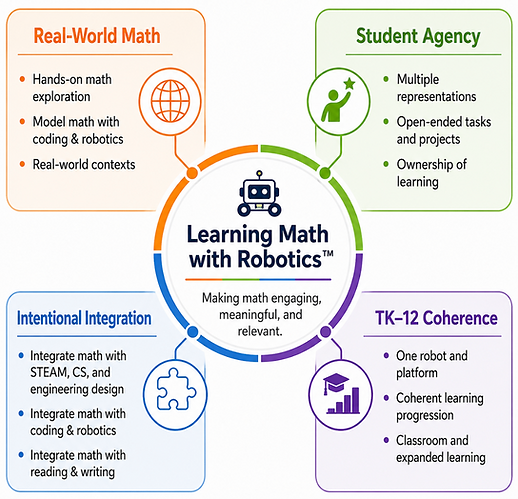
Real-World Math
Students strengthen mathematical understanding by exploring authentic problems, modeling mathematical ideas with robotics, and connecting classroom learning to meaningful real-world contexts.
Student Agency
Students actively construct understanding through multiple representations, open-ended tasks and projects, collaboration, and ownership of their learning.
Intentional Integration
Math is intentionally integrated with coding and robotics when doing so strengthens mathematical understanding and student learning. Math is integrated with STEAM, computer science, and engineering design to reinforce learning across disciplines and provide authentic real-world applications. Reading and writing are integrated to develop academic language and strengthen mathematical communication and reasoning.
TK–12 Coherence
Students experience a coherent TK–12 learning progression built upon the same curriculum, platform, robotics hardware, instructional philosophy, and Professional Learning, providing connected learning experiences from Transitional Kindergarten through Grade 12.
Student Outcomes
-
Develop conceptual understanding
-
Strengthen computational thinking
-
Improve mathematical reasoning
-
Read, write, communicate, and collaborate
-
Build creativity and confidence
Teacher Outcomes
-
Implement research-informed instruction
-
Differentiate instruction
-
Access high-quality curriculum and resources
-
Collaborate through Professional Learning Communities (PLCs)
-
Support coherent TK–12 implementation
-
Develop, customize, and innovate curriculum
Learning Math with Robotics™ at a Glance
✓ Nation's First Comprehensive TK–12 Mathematics Curriculum for Learning Math with Robotics™
✓ One Robot. One Platform. Unlimited TK–12 Learning Opportunities
✓ Approved for Adoption by the California State Board of Education
✓ High School Courses are UC A–G approved C-STEM Courses
✓ Fully Aligned with State Mathematics Standards and Frameworks
✓ Developed through more than two decades of research and classroom implementation
✓ Virtual and Physical Robots Using the Same Programs
✓ Flexible Implementation for Core and Supplemental Instruction, Intervention, Enrichment, and Expanded Learning
✓ Alignment Guides for 25+ Widely Used Mathematics Programs
✓ Support for 18 Languages
✓ More than 16,800 Lessons, Activities, Projects, and Challenges
Learning in Action
Mathematics Learning in the Classroom
See how students use coding, manipulatives, and robotics to make abstract mathematics concrete, visual, and meaningful.
RoboPlay™ Competitions
RoboPlay™ Competitions include RoboPlay Adventure Competitions (TK–1) and RoboPlay Challenge Competitions (Grades 2–12). Students apply mathematics to creatively solve real-world problems through teamwork in curriculum-embedded, mathematicsfocused robotics competitions.
RoboParade™ Projects
Students showcase creativity, mathematical thinking, engineering design, and coding through collaborative RoboParade projects.
Why Learning Math with Robotics?
RoboBlocky Math™ is a comprehensive TK–12 mathematics curriculum that brings the vision of Learning Math with Robotics™ to life by improving mathematics achievement through coding, manipulatives, and robotics.
Developed in collaboration with the UC Davis C-STEM Center and informed by more than two decades of research and classroom implementation with thousands of TK–12 educators, RoboBlocky Math helps schools and districts integrate coding, manipulatives, and robotics into mathematics instruction through flexible implementation pathways.
RoboBlocky Math is designed to complement the STEAM, Computer Science, and Engineering Design with Robotics Pathways. Schools implementing both curricula may integrate hardware-based mathematics activities into the STEAM pathways while allowing mathematics teachers to focus on core mathematics instruction.
Approved for adoption by the California State Board of Education under the California Mathematics Framework, RoboBlocky Math is fully aligned with state mathematics standards and frameworks.
Guiding Principles and TK-12 Coherence
Using the same robot and platform from TK through Grade 12, students build skills and confidence year after year.
Coding and robotics are integrated strategically and purposefully only when they meaningfully enhance conceptual understanding, mathematical reasoning, engagement, and problem solving.
Most RoboBlocky Math lessons and activities focus on mathematics without requiring coding. When coding is included, teachers and students can run embedded programs and modify program values to immediately observe how changes affect the program output, reinforcing mathematical concepts.
Students experience a coherent learning pathway that progressively strengthen mathematical understanding, computational thinking, engineering design, creativity, and problem-solving while continuing to use the same robot and platform from TK through Grade 12.
.
The same physical and programming tools can be used across all grade levels, allowing students to deepen their learning while using familiar resources year after year.
Flexible Pathways for Every Learner
RoboBlocky Math supports flexible implementation pathways while remaining fully aligned with grade-level mathematics standards.
Core Mathematics Instruction
Teacher-led mathematics instruction for all students.
Acceleration
Accelerated and highly accelerated pathways support diverse student readiness levels and district pathway models.
Supplemental Mathematics Support
Selected lessons and activities that enhance existing mathematics curricula, supported by alignment guides for more than 25 widely used mathematics programs.
Tier 2 Intervention
Scheduled intervention courses for students requiring additional support.
Tier 3 Targeted Support
Paraeducator- and special education teacher-led individualized or small-group instruction.
Expanded Learning
Flexible, standards-aligned robotics and mathematics learning experiences supporting afterschool, summer, intervention, enrichment, MTSS, and community learning programs using the same robot and platform.
The same curriculum supports both intervention and enrichment through flexible pacing and instructional approaches.
Coordinated Mathematics and STEAM Implementation
RoboBlocky Math and the STEAM, Computer Science, and Engineering with Robotics Pathways are designed to provide complementary learning experiences without repeating RoboBlocky activities. Schools implementing both curricula may conduct physical robot-based mathematics activities, including RoboParade™, RoboPlay™ Competitions, and other hands-on robotics experiences, through the STEAM pathways, allowing mathematics teachers to focus on core mathematics instruction. Mathematics teachers may use physical robots for lesson demonstrations when appropriate. This coordinated implementation provides maximum instructional flexibility while preserving a complete mathematics learning experience.
One Robot. One Platform.
Unlimited TK–12 Learning Opportunities
Unlike most educational robotics programs, RoboBlocky uses the same robot hardware, programming tools, and learning platform from transitional kindergarten through high school.
Students progressively deepen their mathematical understanding, computational thinking, engineering design, and problem-solving skills while continuing to learn on familiar tools that grow with them year after year.
The same robot and platform support learning across mathematics, STEAM, computer science, engineering, and robotics, creating a coherent TK–12 learning solution for students and a sustainable implementation model for schools.
Reconfigurable Robots for Unlimited Possibilities

Barobo's patented Linkbot modular robotics technology allows students to quickly build, program, and reconfigure robot systems for diverse projects, engineering challenges, and RoboPlay™ Competitions.
Each Linkbot functions as a programmable robot building block with its own programmable controller, precision actuators, and wireless connectivity. Using Baronbo’s patented SnapConnect technology, students can quickly Design, Build, and Program Their Own Robot Machines without special tools.
Students can further extend their designs through:
-
Virtual and physical robots
-
OmniBot robots
-
Arduino integration
-
Sensor-based robotics
-
LEGO-compatible components
-
3D-printed custom parts
The same robotics ecosystem supports learning from elementary school through advanced high school engineering and computer science projects.
Built for Exploration, Creativity, and Growth
RoboBlocky supports hands-on learning through coding, manipulatives, virtual robots, physical robots, engineering design projects, and collaborative challenges.
The platform includes:
-
Integrated Learning Management System (LMS)
-
Real-time classroom interaction tools
-
Support for 18 languages
-
Block-based coding through C/C++ programming
-
A low floor for beginners and a high ceiling for advanced learners
Students transition naturally from block-based coding to text-based programming while developing mathematical reasoning, computational thinking, creativity, and problem-solving skills.
More than 16,000 lessons, activities, Big Idea Tasks, Big Idea Projects, RoboPlay Adventures, and RoboPlay Challenges support mathematics learning, intervention, computer science, engineering design, and expanded learning programs.
Instructional Resources and Teacher Support
RoboBlocky Math is designed to empower all teachers, including those without prior coding or robotics experience, to confidently guide students in making mathematics meaningful, engaging, and accessible.
RoboBlocky Math includes:
-
Comprehensive Instructor Handbooks
-
Student Workbooks (print editions in English and Spanish)
-
Digital resources in multiple languages
-
Ready-to-run programs in lesson Examples that support teacher-led mathematics instruction
-
Structured lessons and guided activities integrating hands-on manipulatives, coding, virtual robots, and physical robots
-
Teachers can modify program values to immediately observe how changes affect the program output, helping students visualize mathematical relationships and deepen conceptual understanding
-
Guided coding activities that provide scaffolded opportunities for students to apply mathematical concepts by modifying program values or selected code, as appropriate for the activity
-
Cross-chapter and cross-grade Big Idea Tasks (K–5), Big Idea Projects (6–12), RoboPlay Adventures (K-1), and RoboPlay Challenges (2-12) to promote deeper mathematical understanding
Real-Time Classroom Interaction: Interactive lessons provide immediate student responses that support ongoing formative assessment, allowing teachers to monitor understanding, identify misconceptions, and adjust instruction in real time.
Teachers can build upon existing RoboBlocky lessons and activities by copying, modifying, and creating their own content, empowering educators to adapt instruction for local needs while maintaining alignment with instructional goals and standards.

Professional development and implementation support help educators successfully implement mathematics, coding, and robotics instruction while empowering teachers as leaders in innovative mathematics education.

Through its partnership with UC Merced Professional and Continuing Education (PACE), Barobo supports teacher preparation and professional development that help educators inspire a love of mathematics.
Research-Informed Instruction
RoboBlocky Instructional Strategy for Excellence (RISE)
A research-informed instructional framework supporting conceptual understanding, mathematical reasoning, inquiry, problem solving, and academic language development.
REST (Run, Explain, Step, and Talk)
A structured instructional model supporting inquiry-based learning, prediction, explanation, discourse, and collaborative problem solving through coding and robotics experiences.
Together, these frameworks strengthen mathematical reasoning, discourse, engagement, inquiry, and student ownership of learning.
Beyond Mathematics
Learning Math with Robotics™ is part of the broader RoboBlocky learning solution, extending beyond mathematics into STEAM, computer science, engineering design, robotics, and expanded learning.
STEAM, Computer Science, and Engineering with Robotics Pathways (K-12)
Students engage in:
-
Computational Storytelling
-
Engineering Design with Robotics
-
Design, Build, and Program Your Own Robot Machines
-
Physical Computing with Arduino and Sensor-Based Robotics
-
Creative Robotics Projects
-
RoboParade™
-
RoboEngineering Expo™
-
RoboPlay™ Competitions
By integrating science, technology, engineering, arts, and mathematics (STEAM), students develop computational thinking, engineering design, creativity, communication, collaboration, and problem-solving skills.
Robotics and Robotics-Math Curriculum for Expanded Learning (TK-12)
Designed for afterschool, summer, and expanded learning programs, these pathways provide additional opportunities for students to explore robotics, mathematics, computer science, and engineering through engaging hands-on experiences using the same tools and technologies used in classroom instruction.
Proven Impact
Develop All Students to Think and Reason as Mathematicians
RoboBlocky Math helps students develop mathematical reasoning, confidence, perseverance, creativity, and problem-solving skills.
In one documented implementation, the percentage of sixth-grade students meeting or exceeding standards on the SBAC mathematics assessment increased from 16% to 71% within one year—a 344% improvement.

Join Us in Shaping the Future of
Mathematics Education
